
Annual Aerosol Science Conference 2026
The Hub are heading to The Royal Society of Chemistry, London, for the Annual Aerosol Science Conference. Held on 23rd and 24th November 2026, the Hub will join the celebration of the 40th anniversary for UK and Ireland Aerosol Society’s 40th anniversary and present our research through oral presentations, posters and an exhibition stand.
Hub oral presentations include:
Sohaib Ikram (PhD, University of Hertfordshire) - Evaluation of Dry Electrostatic Precipitators for Airborne Human DNA Collection in Multi-Occupant Settings
Dr Etelka Chung (Research Fellow, University of Hertfordshire) - Bioaerosol collection into an isolated liquid film

Poster presentations include:
Tanojit Paul (PhD, University of Hertfordshire) - Comparative Assessment of Bioaerosol Collection Platforms for Molecular Surveillance of Airborne Pathogens in Commercial Poultry Facilities
Gözde Isik (PhD, University of Hertfordshire) - Comparison of Bioaerosols Samplers for Microbial Recovery in Controlled Aerosol Chamber
Reece Dillon (PhD, Cranfield University) - Real-time detection and characterisation of bioaerosols in residential environments within the UK
James Summers (PhD, University of Hertfordshire) - HYDRA – Hydrogels for Aerosol Capture
Dr Ying Guo (Research Fellow, Cranfield University) - Do Mouldiness and Relative Humidity Influence the Airborne Concentration and Phase Partitioning of Microbial Volatile Organic Compounds in Indoor Environments?
Shamil Rafeeq (PhD, University of Hertfordshire) - Performance Evaluation of Bioaerosol Samplers for the Collection of Fungal Spores and Polystyrene Latex Microspheres in a Controlled Environment.
Andi Ramadhani (PhD, University of Hertfordshire) - Investigating Airport-Associated Particle Number Concentrations and Elemental Composition around London Gatwick Airport
David Topping (Professor of Digital Environment, The University of Manchester) - AeroSysProp: making aerosol property prediction ready for AI agents, and testing whether agents use it correctly
We are also thrilled to celebrate Professor Daniel McCluskey's hard work before he passes the torch as President.
Cranfield University exhibits include:
🔹Spectral Intensity Bioaerosol Sensor (SIBS) – Showcased by Reece Dillon (PhD candidate - supervised by Professor Zaheer Nasar).
SIBS measures individual airborne particles in real time, recording their size, shape and biological fluorescence across 16 wavelength bands (298–735 nm) using two excitation wavelengths (285 and 370 nm). Each particle produces a detailed fluorescence profile, enabling improved biological classification and identification across different particle populations. SIBS builds on the Wideband Integrated Bioaerosol Sensor (WIBS), originally developed at the University of Hertfordshire in 2005 by Professor Paul Kaye, and is now manufactured by Droplet Measurement Technologies (USA) under licence from the University of Hertfordshire.
🔹 LifeTrack – Showcased by Hasandara Sudangama (PhD Candidate supervised by Dr Licia Dossi). LifeTrack is a handheld prototype 'sniffer' designed to detect hazardous chemicals at extremely low concentrations, from parts per million (ppm) to parts per trillion (ppt). The system uses a 2D matrix array of printed dye dots that change colour/intensity when exposed to different volatile organic compounds (VOCs). Cranfield-developed algorithms and machine learning are used to analyse the pattern of changes and classify the substances detected. LifeTrack has potential applications for detecting illicit chemicals, pesticides, and bioaerosols, as well as for environmental monitoring.
University of Hertfordshire exhibits include:
🔹 Compact Personal Aerosol Sampler (CPAS) – A wearable device for collecting airborne particles and monitoring personal exposure to hazardous substances.
🔹 Optical Particle Counter (OPC) – Measures the size and concentration of airborne particles.
🔹 Electrostatic Precipitator (ESP) – Collects and concentrates airborne particles for further biological analysis.
🔹 Particle Phase Discriminator (PPD) – Uses scattered laser light to analyse aerosol and cloud particles in real time, determining their size, shape and phase (liquid or ice).
Similar Articles
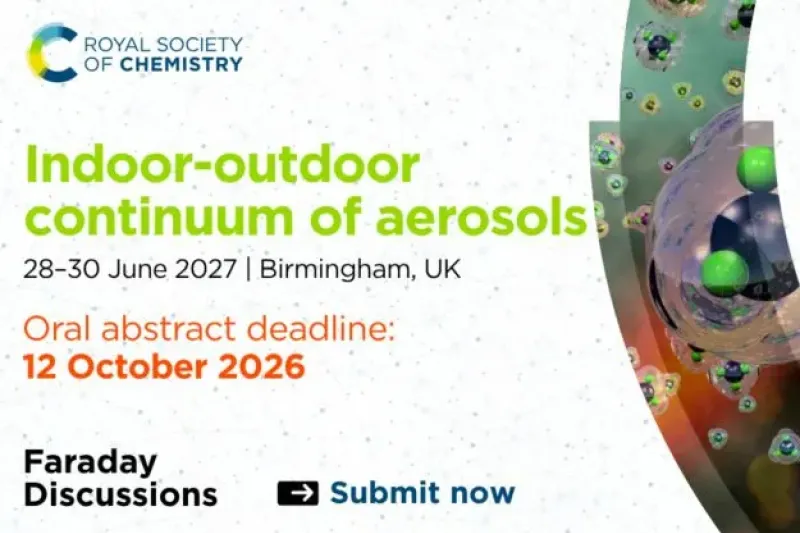
12 October 2026
Royal Society of Chemistry Faraday Discussion

5 October 2026
ABSW Media Fellow 2026